
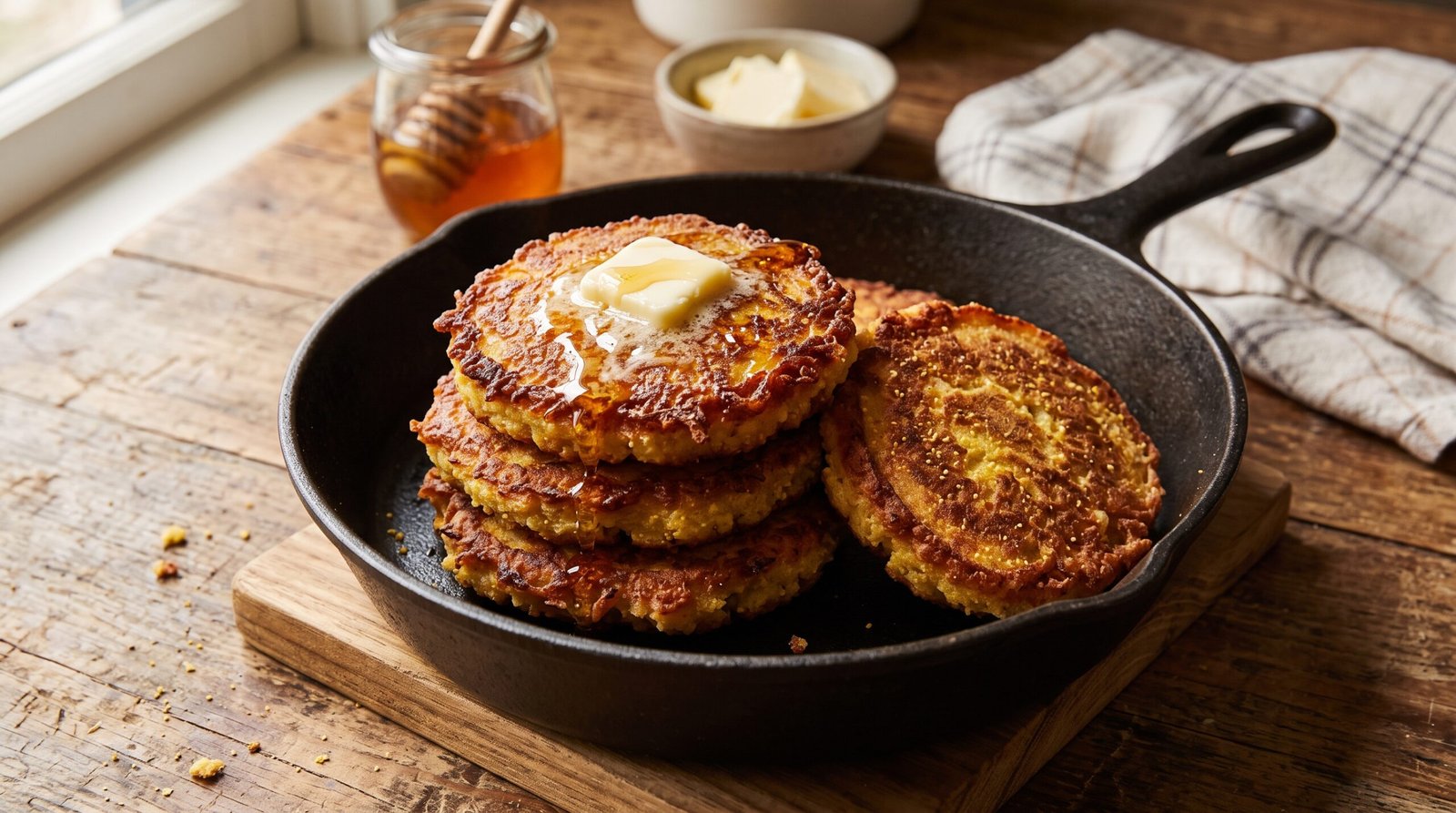
Few dishes capture the heartwarming nostalgia and humble simplicity of traditional American culinary history quite like Old-Fashioned Southern Hoe Cakes. Known across various Southern regions as Fried Cornbread, Johnnycakes, or Cornmeal Griddle Cakes, these golden pan-fried gems represent the ultimate rustic comfort.
Legend holds that these cakes were originally cooked by early American farm workers over the hot blade of a garden hoe held directly above glowing hearth fires—hence their enduring name. While modern home cooks thankfully utilize the magic of a seasoned cast-iron skillet, the soul-satisfying result remains unchanged: an irresistibly crunchy, lacy-edged exterior that gives way to a soft, steaming, buttery cornbread crumb inside.
Whether you serve them at breakfast drizzled with raw wildflower honey and warm maple syrup, or plate them alongside a steaming bowl of collard greens, pinto beans, or slow-cooked beef stew, this classic recipe will instantly become a treasured staple in your kitchen.
⏱️ Recipe Snapshot:
- Prep Time: 10 minutes
- Resting Time: 10 minutes
- Cook Time: 15 minutes
- Total Time: 35 minutes
- Yield: 8 to 10 golden hoe cakes
- Cuisine: Traditional Southern American / Heritage Comfort Food
The Secrets to Achieving That Signature Crispy, Lacy Crust
To achieve true Southern diner perfection, keep these fundamental cooking principles in mind:
- The Indispensable Cast-Iron Skillet: While a standard non-stick frying pan will cook the batter, nothing replicates the intense, uniform heat retention of seasoned cast iron. Cast iron gives the edges their signature lacy, fried crunch and deep golden-mahogany color that makes hoe cakes so iconic.
- The Butter & Oil Duo: Frying in butter alone risks burning the milk solids before the interior cooks through, while using only vegetable oil robs the cakes of that rich, comforting flavor. Combining equal parts vegetable oil (or lard) and unsalted butter raises the smoke point while delivering rich dairy flavor.
- The Essential 10-Minute Batter Rest: Yellow cornmeal is denser and thirstier than standard wheat flour. Letting the batter rest for 8 to 10 minutes before it hits the skillet allows the coarse corn kernels to hydrate and soften, preventing a gritty texture and ensuring a moist, tender crumb.
- Buttermilk Acidity: The natural acidity in whole cultured buttermilk reacts with baking soda to create micro-pockets of carbon dioxide. This provides a light, tender rise while cutting through the richness of the butter.
🛒 Ingredients You Will Need
- Yellow Cornmeal (1 cup / 150 g): Choose a fine or medium-ground yellow cornmeal for optimal texture and rich, sunny color.
- All-Purpose Flour (1 cup / 125 g): Provides the necessary gluten structure to prevent the cakes from crumbling when flipped in the skillet.
- Baking Powder (1 tbsp) & Baking Soda (1/2 tsp): The dual leavening agents responsible for giving the dense corn batter an airy, tender lift.
- Fine Kosher Salt (1 tsp): Essential for drawing out the natural sweetness of the cornmeal.
- Granulated Sugar (1 to 2 tbsp): A subtle Southern touch that balances the tang of the buttermilk and promotes beautiful surface caramelization.
- Large Eggs (2 eggs): Room temperature eggs bind the batter and contribute rich structure.
- Cultured Buttermilk (1 to 1 1/4 cups): Brings tanginess, moisture, and delicate tenderness.
- Melted Butter (4 tbsp): Cooled slightly before whisking into the wet ingredients for rich interior flavor.
- Skillet Frying Fat: A 50/50 blend of vegetable oil and unsalted butter (or traditional bacon drippings for an authentic smoky kick).
- For Plating: Extra pats of salted butter, pure cane syrup, honey, or warm maple syrup.
👩🍳 Step-by-Step Cooking Guide
Step 1: Whisk the Dry Ingredients
In a spacious mixing bowl, combine the yellow cornmeal, all-purpose flour, baking powder, baking soda, kosher salt, and granulated sugar. Whisk thoroughly with a wire whisk to ensure the leavening agents are distributed evenly throughout the flour.
Step 2: Blend the Wet Base
In a second medium bowl, lightly beat the two eggs. Pour in 1 cup of buttermilk and the melted unsalted butter. Whisk until uniform and slightly frothy.
Step 3: Combine and Rest the Batter
Pour the liquid mixture directly into the dry bowl. Using a silicone spatula or wooden spoon, fold the ingredients together gently until just incorporated and no dry streaks remain. The batter should resemble a thick, pourable pancake batter. If it appears excessively dense, stir in an extra 2 to 3 tablespoons of buttermilk or warm water. Set the bowl aside to rest for 10 minutes.
Step 4: Heat the Skillet to High Sizzle
Set a large 10 or 12-inch seasoned cast-iron skillet over medium heat and allow it to preheat for 4 to 5 minutes. Add 1 teaspoon of vegetable oil and 1 teaspoon of unsalted butter to the pan. Swirl the pan until the butter melts, foams, and begins to sizzle gently.
Step 5: Fry to Lacy Golden Perfection
Using a 1/3-cup measuring scoop, ladle portions of the rested batter into the sizzling skillet, leaving at least 1.5 inches between cakes to allow them to spread. You should hear an immediate, vigorous sizzle as the edges make contact with the hot fat. Cook undisturbed for 2 to 3 minutes until bubbles form and pop on the surface and the underside edges develop a dark, crispy lace.
Slide a thin metal spatula cleanly underneath each cake and flip in one confident motion. Cook the second side for another 1.5 to 2 minutes until deeply browned and slightly puffed.
Step 6: Stack, Butter, and Devour
Transfer the cooked hoe cakes to a warm platter or keep them warm inside the cast-iron pan for a rustic presentation. Stack them high, immediately place a generous pat of butter on top so it melts down the sides, and serve piping hot alongside honey or your favorite savory Southern meal!

Leave a Reply